WordPress Security • SEO Integrity
The Pharma Hack: How Your WordPress Site Is Silently Selling Viagra to Google
The call comes out of nowhere. A client's website looks completely normal — the homepage loads fine, the contact form works, the images are correct. Nothing in the admin panel raises any flags. But somewhere inside that site, thousands of pages advertising Viagra, Cialis, and generic erectile dysfunction medications are being indexed by Google under the client's domain. The rankings for their real content have collapsed. A Google Search Console manual action may be pending. And the attack has been running silently for four months.
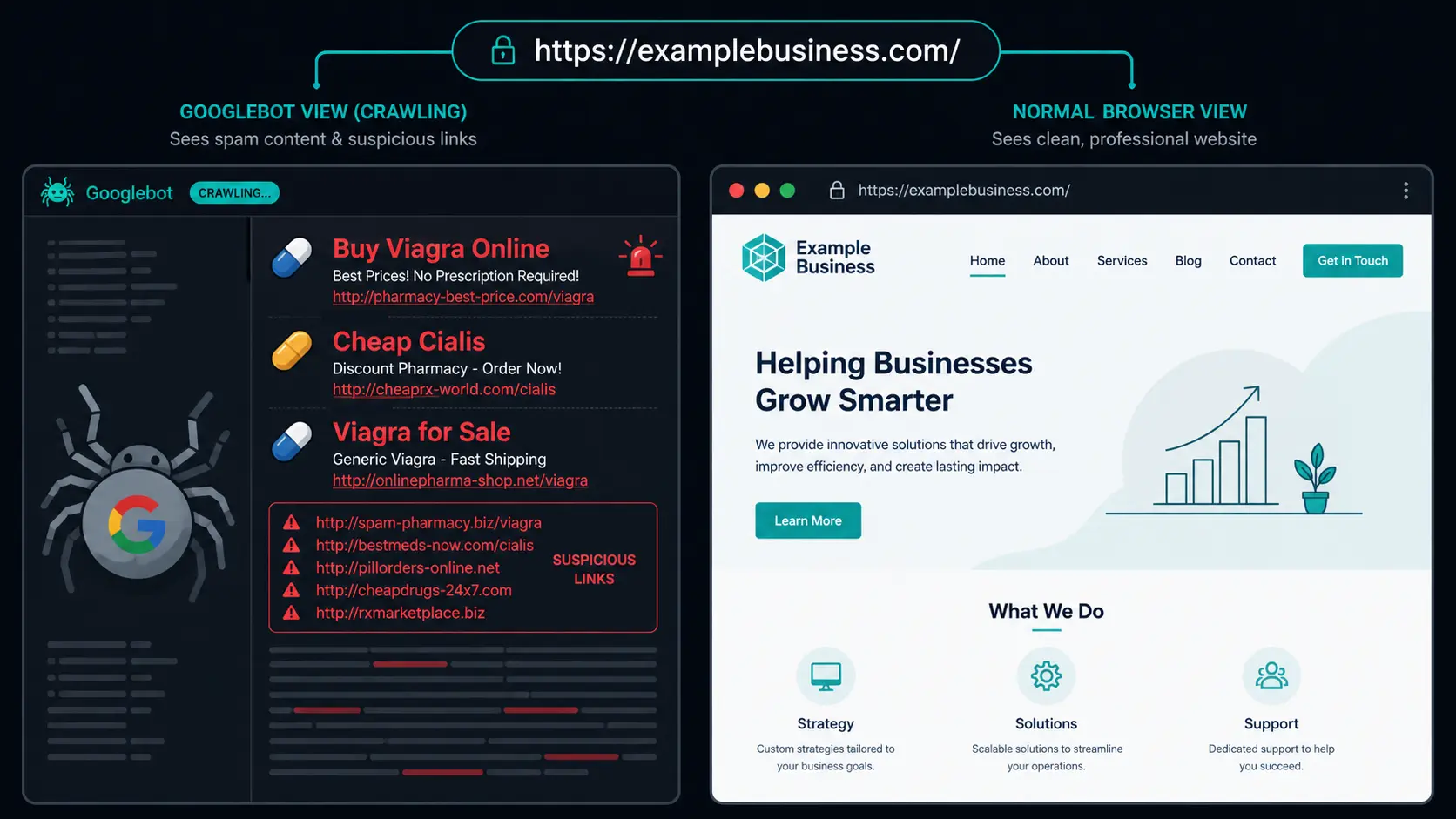
This is the pharmaceutical SEO hack — one of the most common, most damaging, and most consistently underestimated attacks in the WordPress ecosystem. It is not a new attack, but its execution has become significantly more sophisticated. The reason it persists is simple: it uses cloaking. The spam content is never shown to real visitors or to the site owner. It is shown exclusively to Googlebot — which is precisely why it can run undetected for months.
1. What the pharma hack actually does
A pharmaceutical SEO injection attack has one goal: to use your domain's authority and age to rank spam pages in search results. Your site becomes a vehicle for a black-hat SEO operation that you know nothing about.
Once inside, the attacker injects hundreds or thousands of new pages into the site. These pages are typically built around high-volume pharmaceutical search terms: "buy Viagra online," "cheap Cialis no prescription," "generic sildenafil UK." The pages contain keyword- stuffed content, links to external pharmacy sites (usually operating outside regulated markets), and structured markup designed to generate Google rich snippets.
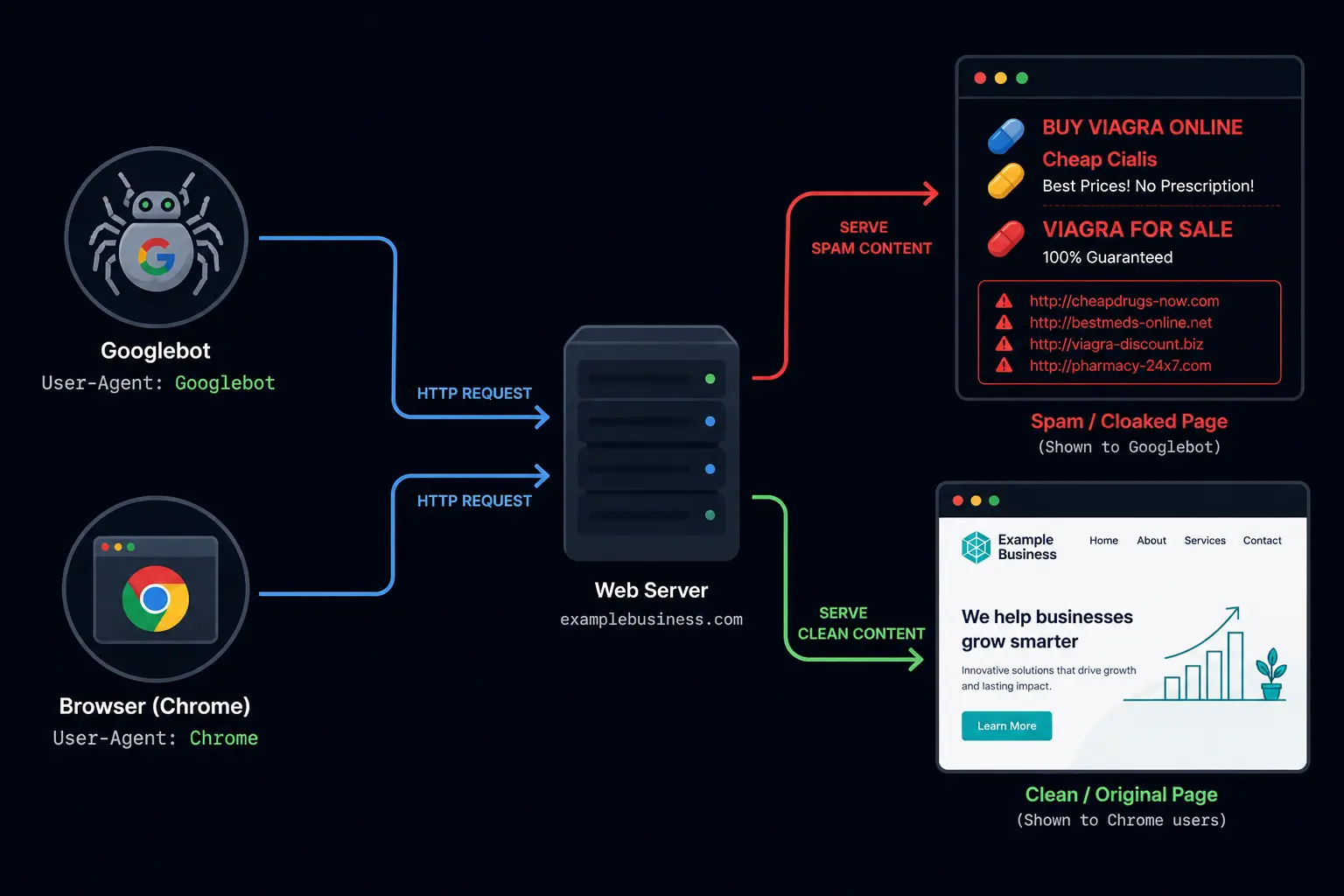
The key technical component is that these pages are conditionally served. When a visitor opens the URL in a browser, they see your normal content — or a redirect to your homepage. When Googlebot requests the same URL, it receives the full spam page. This is textbook cloaking, executed specifically to prevent detection by the site owner while maintaining search engine visibility for the spam content.
2. How it gets in: the entry points
The pharma hack does not require a zero-day exploit or advanced penetration technique. In the vast majority of cases, it enters through one of four well-documented vectors — all of which are preventable and all of which are common in neglected WordPress installations.
Outdated plugins and themes
This is the most common entry point by a significant margin. Vulnerabilities in popular WordPress plugins — page builders, form plugins, SEO plugins, WooCommerce extensions — are discovered and disclosed publicly. Exploit code typically circulates within hours of a CVE publication. Sites running unpatched plugin versions are automatically targeted by scanning bots that look for specific version fingerprints.
The attacker does not manually select your site. An automated scanner identifies it as vulnerable, an automated exploit injects the payload, and the site joins a managed pool of compromised domains. This process can complete in under 30 seconds from initial scan to successful injection.
Nulled themes and plugins
Premium WordPress themes and plugins distributed through unofficial channels (often called "nulled" versions) frequently contain backdoors pre-installed by the distributor. Installing a nulled theme is, in many cases, installing malware deliberately. The pharma injection payload is one of the most common secondary payloads delivered through these backdoors.
Compromised hosting credentials
FTP credentials, cPanel passwords, and database access credentials obtained through phishing, credential stuffing, or shared hosting breaches can give an attacker direct file system access. At that point, the injection can be placed in any file — including WordPress core files — without leaving traces in the WordPress admin log.
Persistent backdoors from previous infections
A site that was previously compromised and "cleaned" without a full forensic investigation may still contain active backdoor files. The pharma hack is frequently a secondary infection that re-enters through a backdoor left by an earlier, different attack — which means cleaning only the visible spam without addressing the access mechanism results in reinfection, often within days.
3. The cloaking mechanism: why you never see the spam
The defining technical characteristic of the pharma hack is
user-agent-based cloaking. The injected code checks the HTTP
User-Agent header of every incoming request and branches on it. The logic is straightforward
but highly effective:
- If the request comes from Googlebot, Bingbot, or another major search crawler — serve the full pharmaceutical spam page, including all keyword content, spam links, and structured data.
- If the request comes from any other user agent — redirect to the legitimate homepage, or serve the real page content. The visitor and the site owner see nothing unusual.
More sophisticated variants also check the HTTP referrer. If the
visitor arrives via a Google search result (referrer contains
google.com), the spam page is served even to a real browser — because the
attacker wants the landing page to match what the user searched for.
If the visitor navigates directly or arrives from any other source,
they are redirected away. This dual-condition check makes it nearly
impossible to reproduce the malicious behavior by simply visiting the
URL directly.
The injection point varies by attack variant. Common locations include:
- 1 WordPress .htaccess — rewrite rules that intercept requests at the Apache/Nginx level before PHP executes, serving different content based on the user agent string.
- 2 wp-config.php or index.php — obfuscated PHP code prepended or appended to core WordPress files that runs before the normal WordPress bootstrap.
- 3 Fake plugin directories — new
folders placed inside
wp-content/plugins/with obfuscated PHP files that load silently when WordPress initializes. - 4 Database injection — spam content stored directly in WordPress post rows, activated by a trigger in a theme function or plugin, invisible in the WP admin because the display logic is also injected.
4. Why this stays invisible for months
The average dwell time for a pharma hack — the period between initial compromise and detection — is typically between 2 and 6 months. Understanding why requires looking at where site owners actually spend their attention.
The site "works" in every normal check
Loading the homepage in a browser: normal. Checking the contact form: works. Logging into WordPress: no warnings. Running a speed test: passes. Looking at Google Analytics: traffic looks stable initially. None of the standard operational checks a freelancer or site owner performs after a maintenance visit would reveal anything wrong.
Google Search Console warnings arrive late — or not at all
Google Search Console may eventually show a Manual Action notice for "Pure spam" or "Cloaking and/or sneaky redirects." But this notice typically arrives weeks or months after the injection — after Google has already crawled, indexed, and processed thousands of spam pages. By then, the domain's authority has been diluted, the crawl budget has been partially consumed, and organic rankings may have already dropped.
More insidiously, many compromised sites never receive a Manual Action notice because the spam pages are not penalizing the site directly — they are benefiting the attacker's external domains through the link equity they drain. The compromised site continues ranking normally for its real queries while slowly hemorrhaging authority to spam destinations.
Organic traffic decline is gradual and easy to misattribute
When rankings do begin to drop, the decline is typically slow — losing one to three positions per week rather than collapsing overnight. This gradual degradation is easy to attribute to seasonal variation, a competitor's new content, or an algorithm update. By the time the pharma hack is identified as the cause, significant ranking ground may have been lost that takes months to recover even after a full clean.
5. How to detect a pharma hack
Detection requires looking at your site from Google's perspective, not from a browser. The following methods are ordered by speed and accessibility — start with the fastest checks first.
Site: operator search
Open Google and search for:
site:yourdomain.com viagra
If results appear listing pharmaceutical content under your domain,
the infection is active and indexed. Also try variations:
site:yourdomain.com cialis, site:yourdomain.com "buy online", site:yourdomain.com pharmacy. A clean site returns zero results for these queries.
Google Search Console — Index Coverage
Go to GSC → Index → Pages. Look at the total indexed page count. If
your site has 40 pages but GSC reports 4,000 indexed URLs, something
has generated pages you did not create. Open the URL list and inspect
the paths — pharma injection URLs typically follow patterns like
/buy-viagra-online-cheap/, random alphanumeric strings, or keyword chains. Also check the
"Manually removed" and "Crawl anomalies" sections for warning signals.
Fetch the URL as Googlebot manually
In GSC, use the URL Inspection tool → "Test Live URL" → "View Tested Page" → "More info" → "HTML" tab. This shows the raw HTML that Googlebot received for that URL. Compare it against what you see in your browser. If the HTML content differs structurally — different links, extra text, different body content — cloaking is active.
For a faster, more systematic check across all monitored URLs, this is exactly what CloakScan automates: a parallel fetch with both a real browser user agent and Googlebot's user agent, followed by a structural HTML diff. If the two responses diverge, you receive an alert immediately — without having to manually check each URL in GSC one by one.
6. Incident response: cleaning a pharma hack
Cleaning a pharma hack correctly requires addressing both the payload (the spam content) and the access mechanism (how it got in and how it persists). Cleaning only the visible spam without finding the backdoor results in reinfection, usually within 24 to 72 hours.
Step 1 — Contain first, investigate second
Before touching any files, take the site into maintenance mode and take a complete backup — including the database and all files — of the infected state. This is your forensic baseline. Changing files before documenting the infection can destroy evidence you need to find the entry point.
Step 2 — Audit recently modified files
Run a file modification timestamp scan. On Linux hosting:
find /path/to/wordpress/ -type f -name "*.php" -mtime -90
This lists all PHP files modified in the past 90 days. Compare the
results against your expected file list — any file you did not
deliberately modify is suspicious. Pay particular attention to core
WordPress files (
wp-includes/, wp-admin/) which should never change between WordPress version updates.
Step 3 — Scan for obfuscated code patterns
Pharma hack payloads are heavily obfuscated to evade signature-based detection. Look for these patterns in PHP files:
-
base64_decode(— indicates encoded payload strings -
eval(gzinflate(— compressed, encoded execution chain -
$_SERVER['HTTP_USER_AGENT']— user-agent check for cloaking logic -
$_SERVER['HTTP_REFERER']— referrer check for search-engine-origin cloaking -
Long random-looking variable names (
$Kx7bQnR) — obfuscation artifact
Step 4 — Clean WordPress core, plugins, and themes
Replace all WordPress core files from a clean download of the same version. Remove all plugins and re-install from official sources — do not restore plugin files from backup because the backup may contain the infected versions. Replace the active theme with a fresh installation. Update every plugin and theme to the latest version immediately.
Step 5 — Audit the database
Search the WordPress database for pharmaceutical keywords and suspicious URLs in post content, post meta, and option values:
SELECT * FROM wp_posts WHERE post_content LIKE '%viagra%';

SELECT * FROM wp_options WHERE option_value LIKE '%eval(%';
Step 6 — Change all credentials
After cleaning: change the WordPress admin password, the database password (and update wp-config.php), the hosting panel password, the FTP/SFTP credentials, and generate new WordPress security keys in wp-config.php. If any of these credentials were reused elsewhere, change them there too.
Step 7 — Request reconsideration if a Manual Action was issued
If Google Search Console shows a Manual Action, submit a reconsideration request after the clean is complete. Document what was found, what was removed, and what measures were taken to prevent reinfection. Reconsideration reviews typically take 1 to 4 weeks. Rankings may begin recovering during this period but full recovery often takes 2 to 3 months after the Manual Action is lifted.
7. Prevention: what actually reduces the risk
No measure eliminates risk entirely, but the following practices reduce it dramatically — and, critically, they reduce dwell time when a breach does occur.
- 1 Automated updates for plugins and themes. The window between CVE publication and exploit deployment is measured in hours, not days. Manual update cycles leave sites exposed for days or weeks at a time. Enable auto-updates for all plugins you have validated as stable, and implement a testing workflow for major updates.
- 2 File integrity monitoring. Know what your site's file state should look like so that when it changes unexpectedly, you find out immediately rather than months later. This is the first line of defense for detecting backdoor injections before they are weaponized.
- 3 Regular Googlebot-perspective checks. Because the pharma hack specifically targets what Googlebot sees, the most direct detection method is comparing what your site serves to Googlebot against what it serves to real visitors. Doing this manually is impractical at scale — automating it is not.
- 4 Principle of least privilege on hosting. PHP files in
wp-content/uploads/should not be executable. The database user should not haveFILEprivileges. SFTP access should be scoped per user, not shared. - 5 Never use nulled themes or plugins. There is no scenario in which the risk is worth it. If the cost of a premium plugin is prohibitive for a client project, use a free alternative — not a compromised copy of the paid version.
8. The freelancer and agency dimension
For freelancers and agencies managing client sites, the pharma hack has a dimension that goes beyond technical remediation. When a client's site is compromised, the question that follows — especially if the site is under a maintenance contract — is where the responsibility lies.
This is not a theoretical risk. A client who loses organic traffic for three months because their site was silently serving pharmaceutical spam to Google will want an explanation. Whether that explanation is "this is what happened and here is how I detected and resolved it within 48 hours" or "I did not notice for four months" is entirely determined by whether you had active monitoring in place.
Proactive detection is not just a technical capability — it is a professional differentiator. Being the person who calls the client rather than the person who receives the call is worth more than any remediation skill you can offer after the fact.